


Reinterpreting The French Revolution - A Global-Historical Perspective
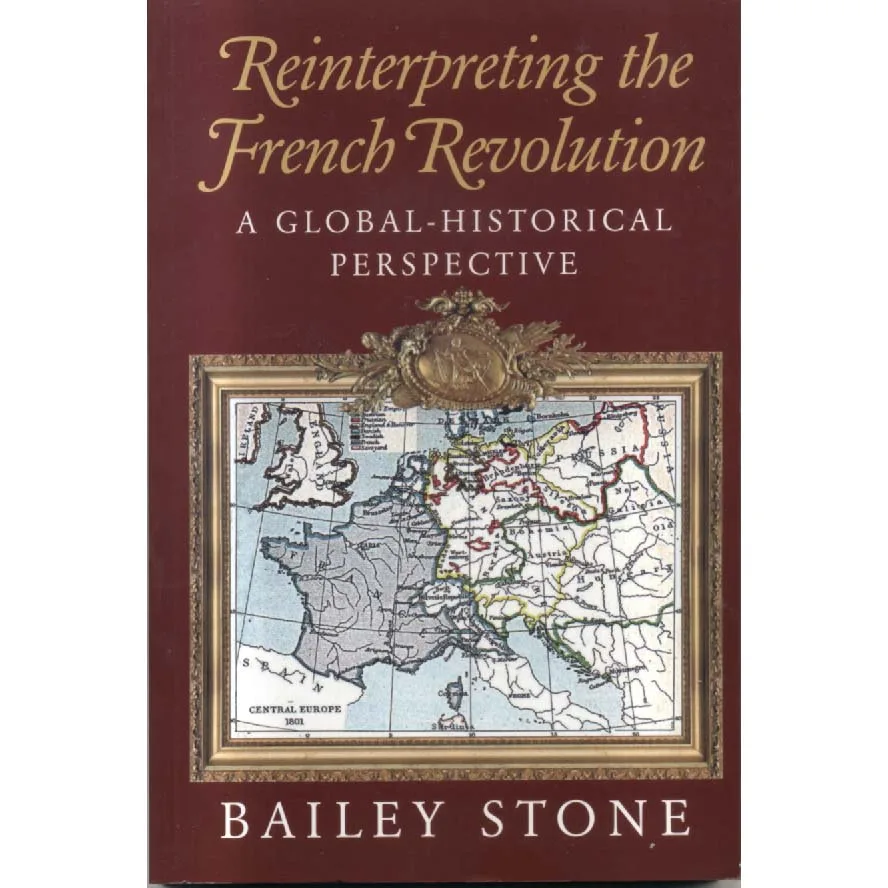
Publisher: Cambridge University Press
Format: Paperback
ISBN: 9780521009997
The French Revolution is one of those events that has been explained so often, so loudly and with such confidence that one could be forgiven for thinking it had become a finished subject: angry peasants, powdered aristocrats, lofty ideals, falling heads, and the general impression that history had suddenly decided to start shouting. Bailey Stone, wisely, is not having any of that.
Reinterpreting the French Revolution – A Global-Historical Perspective (2002) is a book that takes one of the most thoroughly argued-over episodes in modern history and says, in effect, yes, but what if we looked at it properly? Not merely as a national drama of Parisian streets, collapsing monarchy and ideological fervour, but as part of a wider world of empires, commerce, war, intellectual exchange and international pressure. In other words, the Revolution was not just France exploding in isolation. It was France exploding in a crowded room.
Stone’s project is exactly what the title promises: a reinterpretation. This means the book is not content to trudge obediently through the familiar sequence of Estates-General, Bastille, Terror, and Napoleon as though reading out names from a particularly dramatic register. Instead, it asks bigger questions about context, causation and perspective. Why did the Revolution happen when it did? What larger global forces helped shape it? How should we understand it if we stop treating France as a sealed historical container and begin seeing it as part of a broader eighteenth-century world in motion?
This is where the “global-historical perspective” becomes more than an impressive subtitle. The Revolution emerges not simply as a domestic crisis with excellent slogans, but as an event entangled with international rivalry, imperial structures, fiscal pressures, Atlantic commerce, and the circulation of ideas across borders. Which is to say: liberty, equality and fraternity were not generated in some pristine philosophical laboratory. They arrived in a world already full of trade, conflict, competition and contradiction. Even universal ideals, it turns out, tend to travel with baggage.
There is a pleasing irony in this. The French Revolution has often been presented as a grand, singular rupture, a moment when France reinvented politics for the modern age while the rest of the world looked on in shock, admiration or horror. Stone complicates that heroic picture. He reminds us that no revolution, however theatrical, takes place outside history’s wider systems. France was not simply inventing modernity from scratch; it was reacting to pressures, opportunities and patterns that extended well beyond its own borders. The guillotine may have been distinctly French in branding terms, but the forces behind the upheaval were more widely shared.
This makes the book especially appealing for readers who enjoy history with argument in it. Not argument in the sense of shouting, though the Revolution supplies plenty of that on its own, but argument in the more satisfying sense of ideas being tested, assumptions being challenged, and old narratives being politely but firmly pushed aside. Stone is not offering a decorative retelling. He is offering an intervention, which is far more useful if you already know the broad outline and would like to understand why the outline never quite tells the whole story.
For readers of Crappy Old Books, this is exactly the kind of volume that earns its keep by looking scholarly and then justifying the look. It is intelligent, revisionist, and faintly severe in that admirable Cambridge way. The sort of book that suggests you may not only have opinions about the French Revolution, but opinions about the historiography of the French Revolution, which is a level of commitment not to be entered into lightly.
Condition: Good, which is more than can be said for the ancien régime. A solid copy of a thoughtful, challenging and rewarding study that pulls the French Revolution out of its national frame and sets it back into the wider, messier and much more interesting world that helped make it possible.
Keep browsing: See more History books Other books by Bailey Stone
